Posts

Showing posts with the label digital literacy

Let's Talk Digital Procedures!

Image
In a time-honored “beginning of the year tradition,” teachers are going to start the year off going over classroom rules, procedures, and expectations for the year. They will cover everything from bathroom passes, sharpening pencils, turning in assignments, entering and exiting the classroom along with many other expectations.  How much time will classroom teachers spend talking about their digital expectations for students? With schools moving to a 1:1 environment and more and more students showing up with cell phones, it is time to spend just as much time on students' online behavior as you do on their physical actions.  As the teacher, you establish the culture of your classroom with high expectations for student behavior and student to student interactions, both online and face-to-face.   Because accessing devices for learning is an integral part of teaching and learning in Richland 2, it is important that conversations about behavior and consequences h...

New and Revised Curriculum for Digital Citizenship

Image
https://www.commonsense.org/education/digital-citizenship/curriculum One of the critical areas we, as educators, focus on daily with our students is being a responsible citizen in our society. We work on building character skills on a daily basis in various ways, whether it is circle time/morning meeting, community building activities or reteaching those quick lessons when students need a “refresher” on those good habits of mind. The question is, how do you implement the learning required for students to be responsible “digital” citizens? So you know where to start? Common Sense Media has recently released some new and revised lesson plans that are FREE and completely ready to use. Here are some highlights of what you can find on their website: Lessons are organized based on revised topics under the big umbrella of “Digital Citizenship” . This list also reflects the new “scope & sequence” where the first topic is more general, progressing to a more complex topic. ...

Analyzing Graphs and Drawing Conclusions with the New York Times

Do you need a new approach to getting your students to analyze graphs, draw conclusions and even evaluate the reliability of the information? Well, I just saw this on another blog I follow, Teacher Tech with Alice Keeler , and was intrigued by the instructional activity that encourages students to participate in an online moderated conversation about the data and their observations. Graphs display information about politics, policies, pop culture, and daily life topics, bringing in a variety of content related to most classrooms. Students 13 and older can participate in the online moderated conversation, but don't let this discourage you if you teach younger students. Have a whole group discussion and use the teacher account to add the comments, allowing students to have that online learning space opportunity. The 3-day process of analyzing graphs and contributing to the online discussion with the New York Times is the same each week. 1. On  Tuesdays,  the...

Empower Your Students to Responsibly Communicate Online

Image
The beginning of the school year can be overwhelming. From learning new students’ names, establishing norms and classroom rules that students must follow in the classroom to then developing a classroom culture that is safe and conducive to learning, it's no wonder that teachers are unusually exhausted in those first few weeks.  As educators, it is the same “beginning of the year” lecture every time and it is the same presentation for the students every year. Teachers want to ensure students understand what is expected and what a good citizen does in class and school each day. Students practice being a good citizen each day and learn from the mistakes made. When an unacceptable action occurs in the classroom, at lunch or during recess teachers take that moment as a learning opportunity to correct it for the future in hopes it won’t happen again. So as I ask you, can we empower our students to learn to be responsible citizens in the digital space by giving them frequent opportuniti...

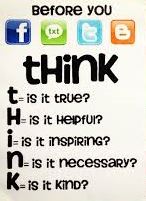
"THINK" Before You Post

Image
Are you aware of the digital footprint you are leaving when you go online? Think about the last thing you did on the internet. Was it a post on Facebook, Twitter or Instagram? Were you shopping on Amazon or another online store? Maybe you were searching for a recent news story that you had heard about on your way to work/school this morning. Whatever the action was, it left a digital footprint that can be traced, searched, copied and shared by anyone. So why is knowing your digital footprint critical? Because it can impact your future no matter your age. The content you post or share online can potentially change a person’s perception of you. Students who apply to join school clubs, athletic teams or even moving onto college could lose an opportunity if a digital footprint was misconstrued or misrepresented their personal image. It can impact a new job whether you are trying to advance in your current career or change careers altogether. Future employers can search your name and lear...

Digital Citizenship Part 2 -Privacy and Security

Do you know the difference between private information and personal information that is safe to publish on the internet? Private information includes your name, address, telephone number, email, and age. This information can be used to steal your money, access personal accounts or even open new credit cards using your identity. Sounds awful, doesn’t it? Personal information pertains to a favorite food, hobby or college football team. This information cannot be used to access your private accounts. Being aware of digital security and practicing responsible online habits protects yourself from digital threats, such as spam, viruses, identity theft and hacking. How does digital security relate to a lesson within your unit? It may not necessarily “fit in” until you see something that sparks the conversation. It reminds of t hose impromptu mini lessons that teachers often have when they see a pattern or an activity that warrants a quick lesson. The tips I list for you are conversatio...

What is Digital Citizenship?

Image
When you hear Digital Citizenship , what first comes to mind? Maybe it’s a combination of thoughts like internet safety, cyberbullying or determining whether it is fake news. The whole idea of digital citizenship can be overwhelming to anyone, especially a teacher or parent. The amount of time our children spend on devices increases annually. We, whether you are a teacher or parent, happen to be the best role models for our students and it’s why I personally want to learn more about digital citizenship. I want to learn all the components of this topic and share my thoughts on this blog as I process the information. My hopes are that you will gain a better understanding of digital citizenship as well and formulate some creative ways to model skills in your classroom. No matter the content that you teach, we need to be able to embrace the power of technology and help our students build healthy habits with technology in order to be successful in the digital age. Common Sense Media de...

Mystery Hangouts

Image
On Global Collaboration day , our team of technology and learning coaches and technology integration specialists participated in a mystery hangout.  It was a new experience for many of the people in the room and it was so much fun.  This blog post will outline how we set up the mystery hangout, what we learned in the process, and ideas for teachers when implementing mystery hangouts in the classroom. We found a class to hangout with by requesting a connection in the Connected Classrooms Google Plus Group .  Here we posted the time and date we were seeking a connection and a general description of what we were hoping to accomplish. Before the hangout, our technology and learning coaches brainstormed two yes/no questions to ask the students regarding their location on the other side of the computer screen. We joined the hangout at the predetermined time and got to work! Takeaways The kids asked way better questions than the adults!  They beat us t...

Being Responsible Digital Citizens

Image
Who is responsible for teaching Digital Citizenship? We all are: educators, parents, Administrators and Instructional Coaches. We all live in this interconnected digital world and must teach, model and talk with our students about what is safe, legal and ethical when it comes to using computing devices. We can no longer assume that someone else will cover digital citizenship. We all need to become proactive and embrace the skills on a daily basis. It's never too early or too late for teachers to embed this in their content. Kids as young as first grade or as old as 12th grade can benefit from these practices. Rather than teaching digital literacy concepts in isolation there are a few ways you can embed these skills into your content. Model the process. While you are discussing facts about the Reconstruction Period, Genetic diseases or the history of a mathematical formula conduct a brief research with your students and talk through the process. When you are post o...